Generator Partial Discharge Online Monitoring
Generator Partial Discharge Online Monitoring
Introduction: OTTAI on-line monitoring system for generator partial discharge is composed of partial discharge sensors, programmable filtering discharge circuits, high-speed signal acquisition and analysis devices, and generator partial discharge expert diagnostic software. This device monitors the changing trend of the partial discharge quantity of the generator, which is an important means to determine the deterioration trend of insulation in advance. Taking remedial measures before the overall insulation deteriorates is beneficial to improving the reliability of the unit operation. Compared with traditional generator partial discharge monitoring equipment, it has functions such as wide-band signal monitoring, time-frequency conversion, cluster analysis extraction, typical discharge spectrum pattern recognition, data trend analysis and query, providing more accurate and effective technical means for evaluating the insulation state of the generator stator winding partial discharge.
1. Background
Partial discharge (PD) is one of the most critical early‑warning indicators of insulation degradation in large generators. Factors such as insulation aging, thermal stress, electrical stress, contamination, and mechanical vibration can lead to PD activity. If not detected early, PD may evolve into insulation breakdown, resulting in severe generator failures and costly outages.
A generator partial discharge online monitoring system provides continuous, real‑time assessment of insulation health. By capturing high‑frequency PD signals and analyzing discharge patterns, the system enables predictive maintenance and significantly enhances operational reliability.
2. System Working Principle
– High‑frequency sensors installed at generator terminals capture PD pulses.
– The data acquisition unit (DAU) filters, amplifies, and digitizes PD signals.
– Communication modules transmit data to the central monitoring platform.
– The platform performs PRPD (Phase‑Resolved Partial Discharge) analysis, trend evaluation, and pattern recognition.
– Automatic alarms and maintenance recommendations are generated based on diagnostic models.
Simplified System Architecture:
[HFCT / UHF Sensors] → [Data Acquisition Unit] → [Communication Network] → [Monitoring & Analytics Platform] → [Alerts • PRPD Charts • Diagnostics]
3. System Components
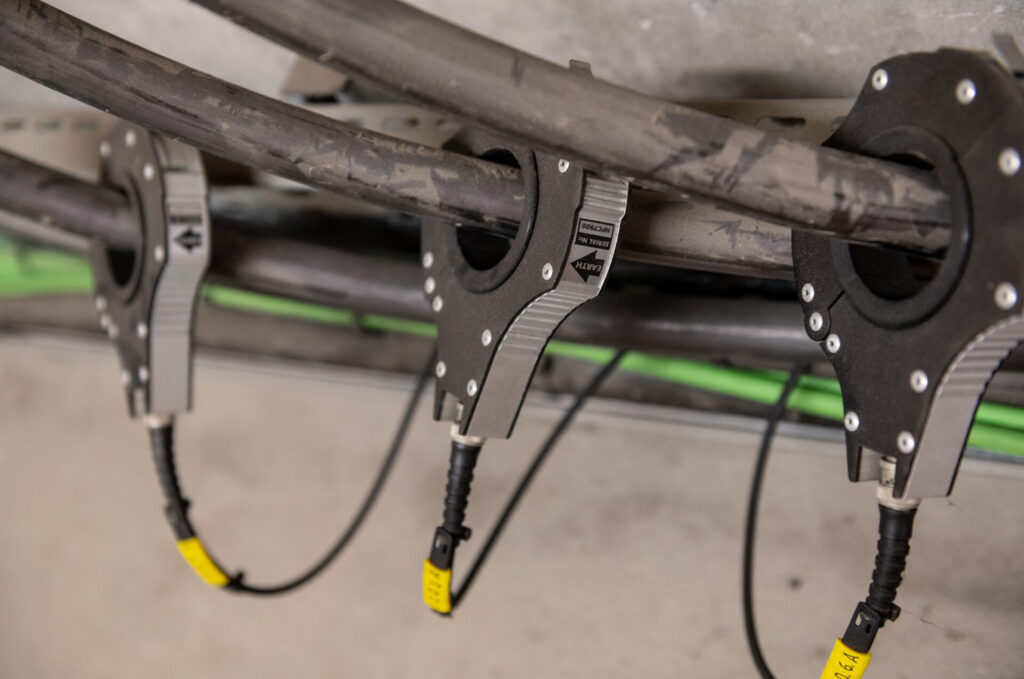
- High‑Frequency Current Transformers (HFCT) — Capture high‑frequency PD pulses from generator terminals.
- UHF Sensors — Detect ultra‑high‑frequency electromagnetic emissions caused by internal PD.
- Coupling Capacitors — Provide stable PD signal extraction for high‑voltage systems.
- Data Acquisition Unit (DAU) — Filters, amplifies, digitizes, and timestamps PD signals.
- Communication Module — Supports fiber‑optic, industrial Ethernet, or wireless communication.
- Central Monitoring Platform — Provides PRPD charts, trend analysis, alarms, and diagnostic reports.
- Cloud or Local Server Deployment — Flexible deployment for utilities and industrial plants.
4. Key Advantages
- Early detection of insulation degradation and PD activity
- Prevention of catastrophic generator failures
- Continuous 24/7 monitoring with high‑accuracy PD pattern recognition
- Supports PRPD, pulse‑counting, and frequency‑domain analysis
- Enables predictive maintenance and reduces unplanned outages
- Enhances reliability of power plants and industrial generation systems
- Compatible with digital power plant and smart‑operation platforms
5. Performance Comparison Table
Parameter | Offline PD Testing | Online PD Monitoring |
Monitoring Frequency | Periodic (annual/biannual) | Continuous (24/7) |
Fault Detection Accuracy | Medium | High (multi‑sensor fusion) |
Sensitivity | Limited by test conditions | High, real‑time |
Operational Impact | Requires shutdown | No shutdown required |
Maintenance Mode | Reactive | Predictive |
Data Availability | Snapshot only | Full historical trends |
6. Recommended Applications
- Large thermal power plant generators
- Hydropower generators
- Nuclear power plant generators
- Industrial captive power plants
- Renewable energy generation units
- Utility asset‑management systems
- Smart power plant digitalization projects
7. Conclusion
A generator partial discharge online monitoring system provides a powerful tool for ensuring generator insulation integrity and operational safety. By integrating high‑frequency sensors, advanced analytics, and real‑time communication, the system enables predictive maintenance and significantly reduces the risk of insulation breakdown. It is an essential component for modern power plants seeking high reliability and digital intelligence.
JUST CLICK FOR BEST SOLUTION
Intelligent temperature and humidity control for both high and low temperatures, provider of power safety solutions