Dry-Type Transformer Temperature Measurement
Dry-Type Transformer Temperature Measurement
Introduction: Fluorescent Fiber Temperature Measurement: Cutting-edge Technology Solving the Challenge of High-Pressure Temperature Measurement
The fluorescent fiber temperature measurement technology boasts core advantages such as resistance to electromagnetic interference and high-precision temperature measurement, and is revolutionizing the field of industrial temperature measurement. Its technical principle is based on the exponential relationship between the fluorescence lifetime of rare earth fluorescent substances (such as Yb³⁺/Er³⁺) and temperature. By measuring the time of light intensity attenuation, the temperature can be inversely calculated using the formula τ(T) = A/(1 + Be^(C/T)), achieving precise temperature measurement. The physical vapor deposition process ensures the uniformity of the nanoscale coating, and the control of ion concentration gradients enables a temperature resolution of 0.1℃, providing quantitative assurance for industrial scenarios.
1. Background
Dry‑type transformers are widely used in commercial buildings, industrial facilities, data centers, and substations due to their safety, environmental friendliness, and low maintenance requirements. However, overheating caused by poor contact, insulation aging, overload, or ventilation issues remains a major risk factor.
Fluorescent fiber optic temperature monitoring provides high‑accuracy, real‑time, and EMI‑immune temperature measurement, making it ideal for dry‑type transformer windings, core surfaces, and critical hotspots.
2. System Working Principle
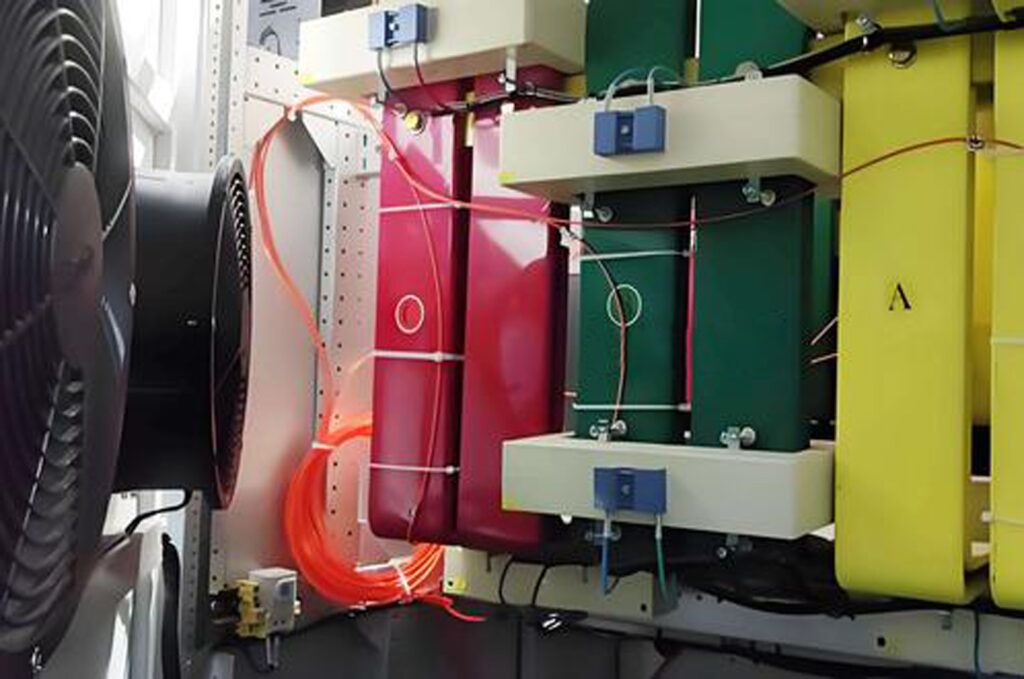
– Fluorescent fiber probes are embedded in transformer windings or mounted on hotspot locations.
– The interrogator excites the fluorescent material and measures fluorescence decay time.
– Decay time is converted into precise temperature values.
– Data is transmitted to the monitoring platform for real‑time display and alarms.
– Trend analysis supports predictive maintenance.
Simplified System Architecture:
[Fluorescent Fiber Probes on Windings] → [Optical Interrogator / Temperature Host] → [Communication Network] → [Monitoring Platform] → [Real‑Time Temperature • Alarms • Trends]
3. System Components
- Fluorescent Fiber Winding Probes — Embedded in LV/HV windings for hotspot monitoring.
- Surface‑Mounted Fiber Probes — Installed on core, clamps, or terminals.
- Optical Interrogator — Converts fluorescence decay time into temperature readings.
- Fiber‑Optic Cables — Provide passive, safe signal transmission.
- Communication Module — Supports RS485, Ethernet, IEC 61850.
- Monitoring Platform — Displays real‑time temperature, alarms, and historical trends.
- Installation Accessories — Probe sleeves, clamps, protective housings.
4. Key Advantages
- Accurate hotspot monitoring inside transformer windings
- Immune to electromagnetic interference (EMI)
- No electrical risk — fully passive optical sensing
- Supports multi‑point temperature measurement
- Enhances transformer safety and lifespan
- Enables predictive maintenance
- Suitable for harsh and high‑voltage environments
5. Performance Comparison Table
Parameter | PT100 / Thermocouples | Fluorescent Fiber Optic Sensors |
EMI Immunity | Low | Excellent |
Safety | Medium | Very High |
Installation in Windings | Difficult / Unsafe | Fully supported |
Accuracy | Medium | High |
Temperature Range | Limited | Wide (‑40°C to 200°C+) |
Maintenance | Moderate | Minimal |
6. Recommended Applications
- Dry‑type transformer LV/HV winding temperature monitoring
- Core and clamp temperature monitoring
- Terminal and busbar hotspot detection
- Data centers and commercial buildings
- Industrial power distribution systems
- Smart grid and digital substation projects
7. Conclusion
Fluorescent fiber optic temperature monitoring provides a highly reliable and safe solution for dry‑type transformer temperature measurement. Its immunity to electromagnetic interference and ability to monitor internal winding hotspots make it essential for ensuring transformer safety, extending service life, and supporting predictive maintenance strategies.
JUST CLICK FOR BEST SOLUTION
Intelligent temperature and humidity control for both high and low temperatures, provider of power safety solutions