Distributed Fiber Optic Temperature Measurement
Distributed Fiber Optic Temperature Measurement
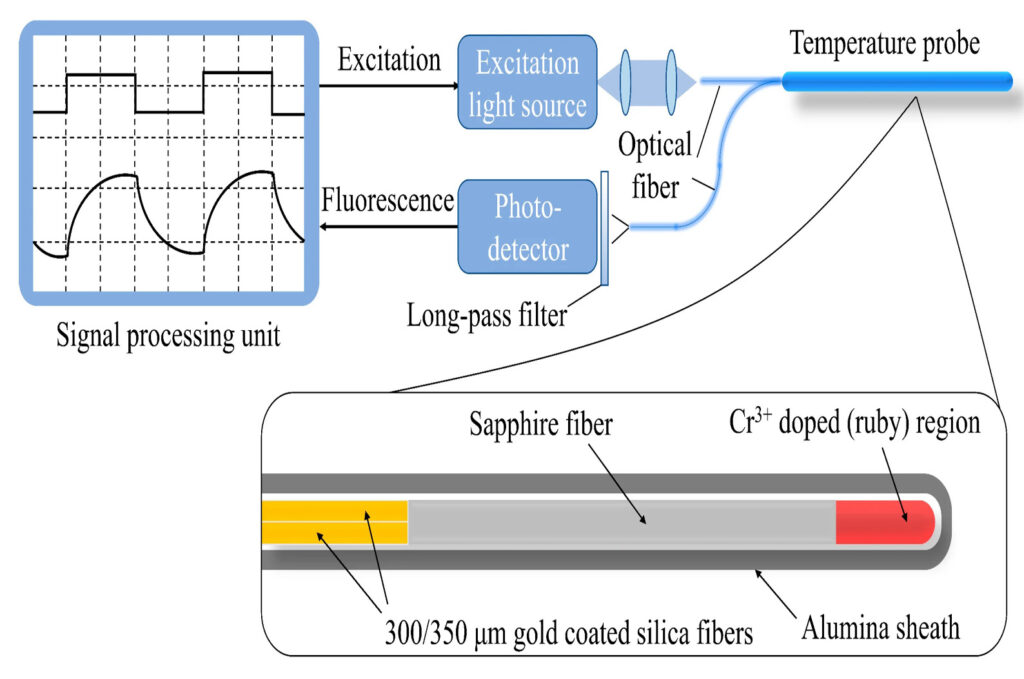
Introduction: The distributed optical fiber temperature measurement system is a real-time, online, and continuous temperature monitoring system. It is developed based on the principles of backward Raman scattering and optical time domain reflectometry (OTDR) positioning. The system has functions such as generating optical signals, spectral analysis, photoelectric conversion, signal amplification, and processing. It uses special temperature-sensing optical cables as temperature sensors, which can accurately measure the temperature at various positions along the laying direction of the temperature-sensing optical cables and locate temperature abnormal points. It has excellent performance indicators and system stability. The system integrates technologies such as computer, optical fiber communication, optical fiber sensing, and photoelectric control, and has inherent safety, corrosion resistance, and immunity to electromagnetic interference. It continuously monitors long-distance and wide-area environmental temperature information, providing high-quality temperature monitoring solutions for fields such as power, petroleum, transportation, and coal mines.
1. Background
Distributed fiber optic temperature monitoring (DFOT) systems use optical fibers as continuous temperature sensors along power system assets such as cables, transformers, bus ducts, and switchgear. By detecting temperature anomalies in real time, DFOT enhances operational safety, prevents thermal faults, and supports predictive maintenance.
2. System Working Principle
– Fiber optic sensing cable installed along the monitored asset
– Distributed Temperature Sensing (DTS) unit sends laser pulses into the fiber
– Backscattered Raman/Brillouin signals are analyzed to determine temperature at every point
– Data acquisition and processing modules extract temperature profiles
– Monitoring platform visualizes temperature trends and triggers alarms
Simplified System Architecture:
[Optical Fiber Sensor Cable] → [DTS Unit] → [Data Processing] → [Monitoring Platform] → [Temperature Analysis & Alarms]
3. System Components
- Fiber Optic Sensing Cable** – Provides continuous temperature measurement along its entire length.
- DTS Unit** – Generates laser pulses and analyzes backscattered signals.
- Data Acquisition Module** – Performs signal processing and temperature calculation.
- Communication Module** – Supports fiber‑optic, Ethernet, or wireless communication.
- Central Monitoring Platform** – Displays temperature profiles, alarms, and historical trends.
4. Key Advantages
- Real‑time continuous temperature monitoring
- High spatial resolution for pinpointing hotspots
- Immune to electromagnetic interference
- Supports predictive maintenance and reduces thermal failure risk
- Suitable for smart grid and digital substation applications
5. Performance Comparison Table
Parameter | Periodic Thermal Inspection | Distributed Fiber Optic Monitoring |
Monitoring Frequency | Annual/Quarterly | Continuous (24/7) |
Temperature Detection Sensitivity | Medium | High (distributed sensing) |
Fault Identification Speed | Slow | Immediate |
Data Accuracy | Medium | High |
Maintenance Mode | Reactive | Predictive |
6. Recommended Applications
- High‑voltage power cables
- Transformers and reactors
- GIS/GIL bus ducts
- Underground cable tunnels
- Renewable energy integration systems
7. Conclusion
Distributed fiber optic temperature monitoring systems provide essential thermal protection for critical power system assets. By enabling real-time, high-resolution temperature monitoring, DFOT systems help detect emerging thermal issues, prevent equipment failure, and enhance the reliability and safety of modern power infrastructure.
JUST CLICK FOR BEST SOLUTION
Intelligent temperature and humidity control for both high and low temperatures, provider of power safety solutions