GIS Partial Discharge Online Monitoring
GIS Partial Discharge Online Monitoring
Introduction: GIS (Gas Insulated Switchgear) is widely used in medium-voltage, high-voltage and ultra-high-voltage substations due to its compact structure and high reliability. During long-term operation, partial discharge (PD) may occur inside the GIS due to insulation defects, installation process issues or aging factors.
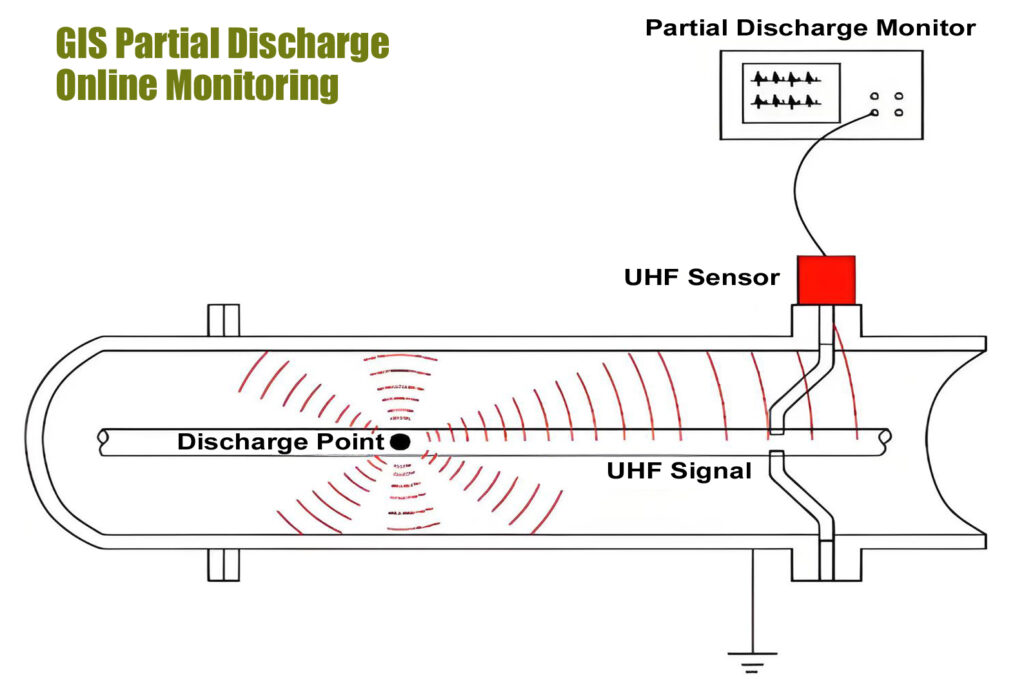
GIS partial discharge online monitoring refers to the process of collecting partial discharge signals in real time through sensors while the equipment is in an energized state, and then analyzing and judging these signals to achieve continuous monitoring of the equipment’s insulation status.
1. Background
Gas‑insulated switchgear (GIS) is widely used in medium‑ and high‑voltage substations due to its compact structure, high reliability, and strong environmental resistance. However, insulation defects—such as metal particles, protrusions, voids, and surface contamination—can lead to partial discharge (PD), which is a major cause of insulation deterioration and catastrophic equipment failure. A GIS partial discharge online monitoring system provides continuous, real‑time detection of PD activity, enabling early fault identification and improving grid reliability.
2. System Working Principle
– UHF, ultrasonic, and TEV sensors detect electromagnetic or acoustic signals generated by partial discharge.
– Sensors transmit raw signals to a data acquisition unit (DAU).
– The DAU performs filtering, feature extraction, and data packaging.
– Communication modules send processed data to a central monitoring platform.
– The platform analyzes PD patterns, identifies defect types, and issues alarms.
Simplified System Architecture:
[UHF/Ultrasonic/TEV Sensors] → [DAU] → [Communication Network] → [Monitoring Platform] → [PD Analysis & Alarms]
3. System Components
- **UHF Sensors** – Detect high‑frequency electromagnetic signals from PD.
- **Ultrasonic Sensors** – Capture acoustic emissions caused by discharge activity.
- **TEV Sensors** – Measure transient earth voltage signals.
- **Data Acquisition Unit (DAU)** – Performs signal processing and data aggregation.
- **Communication Module** – Supports fiber‑optic, industrial Ethernet, or wireless networks.
- **Central Monitoring Platform** – Provides PD pattern recognition, alarms, and historical trend analysis.
4. Key Advantages
- Early detection of insulation defects inside GIS compartments
- High sensitivity to various PD types (voids, particles, protrusions)
- Continuous 24/7 monitoring improves operational reliability
- Supports predictive maintenance and reduces outage risk
- Suitable for digital substation and smart grid applications
5. Performance Comparison Table
Parameter | Periodic Inspection | Online Monitoring |
Monitoring Frequency | Annual/Quarterly | Continuous (24/7) |
PD Detection Sensitivity | Medium | High (multi‑sensor fusion) |
Fault Identification Speed | Slow | Immediate |
Data Accuracy | Medium | High |
Maintenance Mode | Reactive | Predictive |
6. Recommended Applications
- GIS substations (110kV–500kV)
- Underground or indoor substations
- Industrial power distribution systems
- Renewable energy grid‑connection substations
- Smart grid and digital substation projects
7. Conclusion
A GIS partial discharge online monitoring system provides essential protection for high‑value GIS equipment. By continuously monitoring PD activity and analyzing discharge patterns, it enables early detection of insulation defects, prevents equipment failure, and enhances the reliability of modern power systems.
JUST CLICK FOR BEST SOLUTION
Intelligent temperature and humidity control for both high and low temperatures, provider of power safety solutions