Oil-Immersed Transformer Fluorescent Temperature Measurement
Oil-Immersed Transformer Temperature Measurement
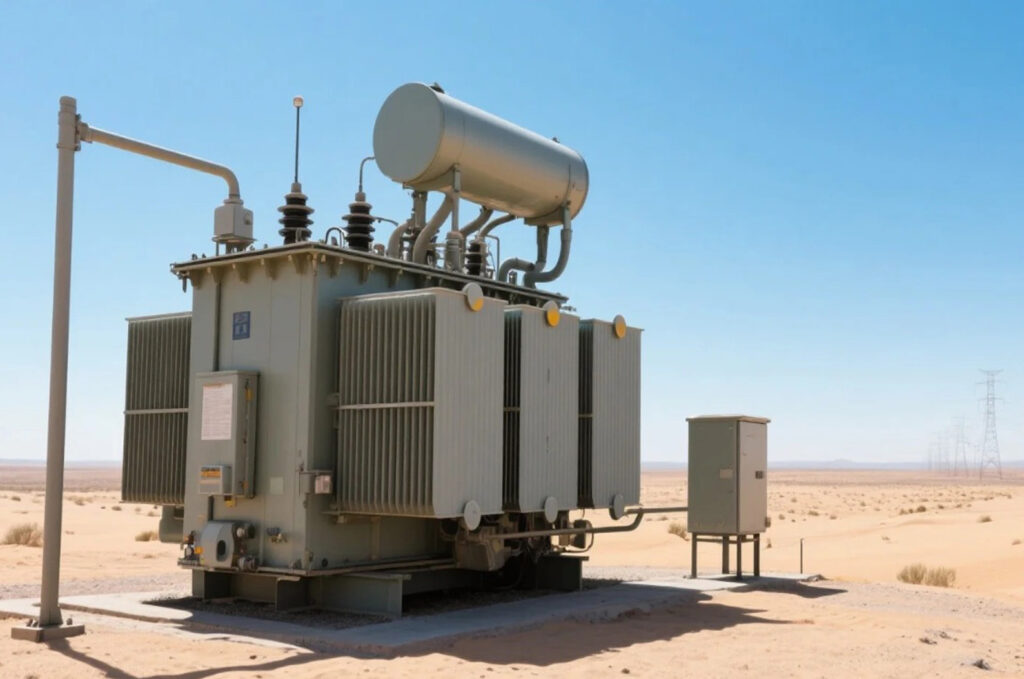
Introduction: In power operation and maintenance, temperature monitoring of oil-immersed transformers is a core issue – according to the “6° rule” of the GB1094 standard: if the hotspot temperature exceeds 98°C, the equipment’s lifespan will be halved for every 6°C increase. Traditional temperature measurement methods (empirical estimation, thermocouples, infrared) often have problems of inaccurate measurement, being susceptible to interference, and high maintenance costs. They frequently cause unplanned shutdowns, with losses reaching hundreds of thousands of yuan each time. The core problem of traditional temperature measurement is “indirect measurement + environmental sensitivity”: the empirical method relies on guesswork, thermocouples are affected by electromagnetic interference (with an error of ±5°C), and infrared cannot detect internal hotspots, all of which cannot meet the requirements for precise monitoring.
The principle of fluorescent optical fiber temperature measurement is simple: When the fluorescent substance at the end of the optical fiber is stimulated by light, the fluorescence decay time changes in a regular pattern with temperature. By measuring the decay time, the actual temperature can be directly obtained, which is equivalent to installing a “direct-to-core thermometer” for the transformer.
1. Background
Oil‑immersed transformers are widely used in transmission and distribution networks, substations, industrial facilities, and power plants. Their operational reliability is critical to grid stability. Overheating caused by insulation aging, overload, poor cooling, or internal faults can lead to severe failures, including transformer explosions or fires.
Traditional temperature monitoring methods (e.g., oil thermometers, RTDs) often cannot measure true winding hotspot temperature, which is the most important indicator of transformer health.
Fluorescent fiber optic temperature monitoring provides direct, real‑time, high‑accuracy, and EMI‑immune hotspot measurement, making it ideal for oil‑immersed transformer applications.
2. System Working Principle
– Fluorescent fiber probes are embedded directly in transformer windings or mounted on core and structural hotspots.
– The interrogator excites the fluorescent material and measures fluorescence decay time.
– Decay time is converted into precise temperature values.
– Data is transmitted to the monitoring platform or SCADA system.
– Real‑time alarms and trend analysis support predictive maintenance.
Simplified System Architecture:
[Fluorescent Fiber Probes in Transformer Windings] → [Optical Interrogator / Temperature Host] → [Communication Network] → [Monitoring Platform / SCADA] → [Real‑Time Temperature • Alarms • Trends]
3. System Components
- Fluorescent Fiber Winding Probes — Embedded in LV/HV windings for true hotspot monitoring.
- Surface‑Mounted Fiber Probes — Installed on core, clamps, and structural components.
- Optical Interrogator — Converts fluorescence decay time into temperature readings.
- Fiber‑Optic Cables — Provide passive, safe, EMI‑immune signal transmission.
- Communication Module — Supports RS485, Ethernet, IEC 61850, or wireless.
- Monitoring Platform — Displays real‑time temperature, alarms, and historical trends.
- Installation Accessories — High‑temperature sleeves, protective tubes, mounting fixtures.
4. Key Advantages
- Direct measurement of winding hotspot temperature
- Immune to electromagnetic interference (EMI)
- High accuracy and long‑term stability
- No electrical risk — passive optical sensing
- Supports multi‑point temperature monitoring
- Enhances transformer safety and lifespan
- Enables predictive maintenance and digital twin applications
5. Performance Comparison Table
Parameter | RTDs / Oil Thermometers | Fluorescent Fiber Optic Sensors |
Hotspot Accuracy | Low | Very High |
EMI Immunity | Medium | Excellent |
Response Time | Slow | Fast |
Installation in Windings | Not possible | Fully supported |
Safety | Medium | Very High |
Maintenance | Moderate | Minimal |
6. Recommended Applications
- Oil‑immersed transformer winding hotspot monitoring
- Core and clamp temperature monitoring
- On‑load tap changer (OLTC) hotspot detection
- Power plants and substations
- Industrial high‑power transformers
- Smart grid and digital substation systems
7. Conclusion
Fluorescent fiber optic temperature monitoring provides a highly reliable and accurate solution for oil‑immersed transformer temperature measurement. Its ability to directly measure winding hotspots, combined with immunity to electromagnetic interference, makes it essential for improving transformer safety, extending service life, and supporting predictive maintenance strategies.
JUST CLICK FOR BEST SOLUTION
Intelligent temperature and humidity control for both high and low temperatures, provider of power safety solutions