Transformer Current Online Monitoring
Transformer Current Online Monitoring
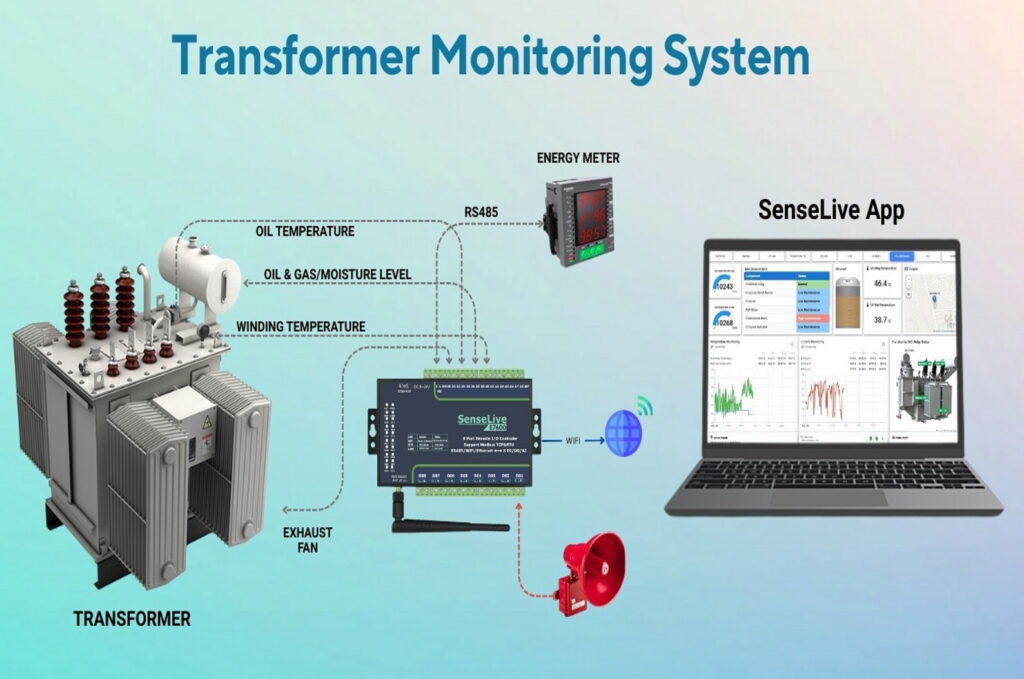
Introduction: Transformers, as the core equipment of the power system, are like the heart of the human body, undertaking the important tasks of voltage transformation, power distribution and transmission. Their operating status directly affects the stability and reliability of the entire power system. Under the traditional operation and maintenance mode, the main reliance is on regular inspections and manual experience-based judgment of the transformer’s operating condition. This approach has obvious limitations. On one hand, the inspection cycle is long, making it difficult to capture real-time changes and potential fault hazards during the equipment’s operation; on the other hand, manual judgment is greatly influenced by subjective factors, leading to possible misjudgments or omissions. With the continuous growth of power demand and the development trend of power system intelligence, the traditional operation and maintenance mode can no longer meet the requirements for ensuring the reliable operation of transformers. Once a transformer fails, it may cause large-scale power outages, bringing significant impacts on social production and life, and causing huge economic losses. Therefore, introducing advanced online monitoring and fault warning technologies for transformers to achieve real-time monitoring of the transformer’s operating status and predict equipment failure risks in advance is of great significance for improving the operational and reliability of the power system.
1. Background
Power transformers are among the most critical assets in transmission and distribution networks. The transformer core is normally grounded at a single point to prevent circulating currents and ensure safe operation. Abnormal grounding current—caused by insulation degradation, core lamination faults, or unintended multiple grounding points—can lead to overheating, partial discharge, or catastrophic transformer failure. A transformer core grounding current online monitoring system provides continuous, real‑time detection of abnormal grounding current to ensure safe and reliable transformer operation.
2. System Working Principle
- A high‑precision current sensor is installed on the transformer core grounding lead.
- The sensor continuously measures leakage current, harmonic components, and transient disturbances.
- Data is transmitted to a data acquisition unit (DAU) for preprocessing.
- Communication modules send the processed data to a central monitoring platform.
- The platform analyzes trends, identifies abnormal patterns, and generates alarms.
Simplified System Architecture:
[Grounding Current Sensor] → [DAU] → [Communication Network] → [Monitoring Platform] → [Analytics & Alerts]
3. System Components
- **High‑Precision Grounding Current Sensor** – Measures AC/DC current, harmonics, and transient spikes.
- **Data Acquisition Unit (DAU)** – Performs sampling, filtering, and data packaging.
- **Communication Module** – Supports fiber‑optic, industrial Ethernet, or wireless networks.
- **Central Monitoring Platform** – Provides dashboards, alarms, and historical trend analysis.
- **Cloud/Local Server** – Stores long‑term data for fault diagnosis.
4. Key Advantages
- Early detection of insulation degradation and core faults
- Prevention of overheating and transformer damage
- Real‑time monitoring of grounding current waveforms and harmonics
- Supports predictive maintenance strategies
- Suitable for power plants, substations, and industrial transformers
5. Performance Comparison Table
Parameter | Manual Measurement | Online Monitoring |
Monitoring Frequency | Periodic (annual/quarterly) | Continuous (24/7) |
Fault Detection Speed | Slow | Immediate |
Harmonic Analysis | Not available | Supported |
Data Accuracy | Medium | High (precision sensors) |
Maintenance Mode | Reactive | Predictive |
6. Recommended Applications
- Power transformers in substations (35kV–500kV)
- Generator step‑up transformers in power plants
- Industrial transformers in manufacturing facilities
- Transformers in renewable energy stations
7. Conclusion
A transformer core grounding current online monitoring system provides essential protection for high‑value transformer assets. By continuously monitoring grounding current and analyzing harmonic characteristics, it enables early detection of insulation faults, prevents equipment damage, and enhances the reliability of power transmission and distribution networks.
JUST CLICK FOR BEST SOLUTION
Intelligent temperature and humidity control for both high and low temperatures, provider of power safety solutions