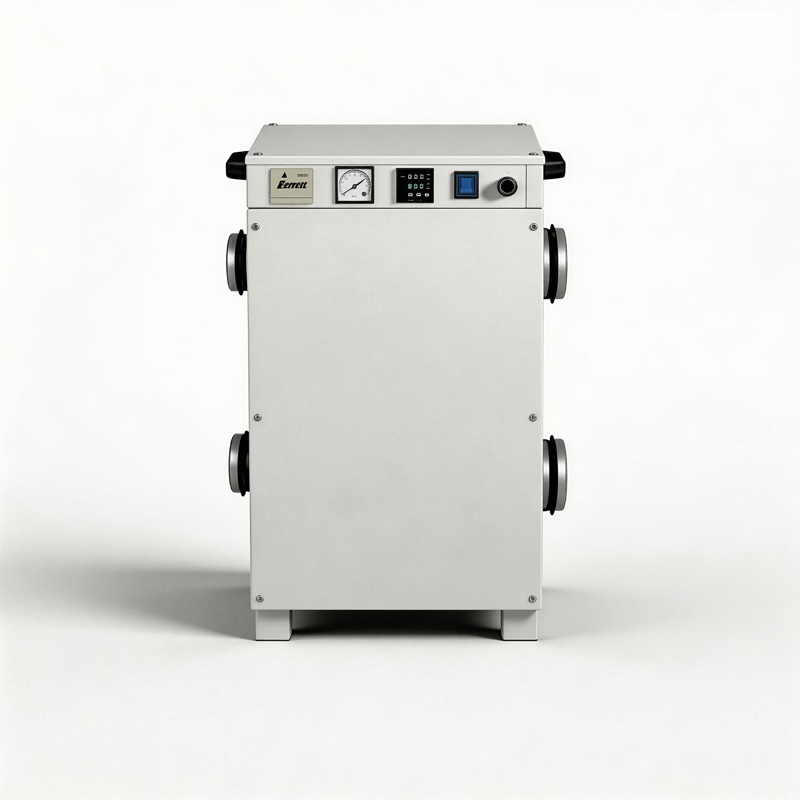
Inside the dehumidifier, the desiccant rotor sealing system divides the unit into a process zone and a regeneration zone. The desiccant rotor rotates slowly at a speed of 8 to 12 revolutions per hour, ensuring that the entire dehumidification operation functions as a continuous process. When the humid air being treated (referred to as “process air”) enters the rotor’s 270-degree process zone, water molecules within the air are absorbed by the desiccant material embedded in the rotor; simultaneously, the water vapor undergoes a phase change, releasing latent heat. Consequently, the section of the rotor located within the process zone becomes increasingly saturated as it absorbs moisture. At this stage, the process air—having lost its moisture content and gained heat from the released latent heat—emerges as dry, warm air, which is then discharged by the process fan.
Concurrently, within the regeneration zone, a separate stream of air first passes through a regeneration heater to become high-temperature air (typically ranging from 100°C to 140°C). This heated air then flows through the moisture-laden rotor section, causing the adsorbed water within the rotor to evaporate and thereby restoring the rotor’s dehumidification capacity. As the regeneration air facilitates the evaporation of moisture from the rotor, it itself becomes humidified air; this humid air is subsequently expelled to the outdoors by the regeneration fan.